Imagine this scene, which might sound familiar. The client, excited, requests a new feature: “We need an AI-powered chatbot on our website! All our competitors have one.” The development team, full of technical talent, dives in headfirst. They spend weeks researching APIs, comparing language models, designing a scalable architecture, and writing impeccable code. The chatbot is deployed and is a technical marvel. But after the launch, the silence is deafening. Users ignore it completely. The business metric it was supposed to improve—let’s say, reducing support tickets—remains unchanged. Did development fail? No. The connection between the feature and the real objective failed. They built the “right thing” impeccably, but they didn’t build “the right thing”.
Now, let’s reframe that same scenario through a different lens. Instead of starting with the solution, we start with a simple but powerful question: Why? Why do we want a chatbot? The goal isn’t “to have a chatbot,” but “to reduce the support team’s workload by 30% by the end of the year.” This is the lighthouse that will guide everything that follows. This shift in mindset is the essence of Impact Mapping.
An Impact Map is a strategic visualization that tangibly and directly connects business goals to development activities. It’s a mind map built collaboratively by answering four key questions in this order: Why? (the goal),
Who? (the actors involved),
How? (the impact we want to have on them), and finally,
What? (the deliverables or functionalities that we, as development, can build).
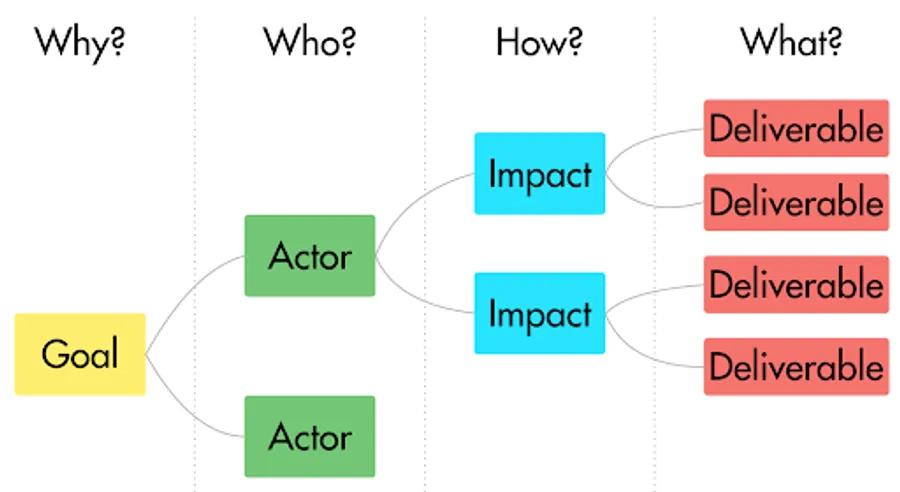
The magic is that the “What” is the last piece of the puzzle, not the first. You stop being a mere requirement implementer and become a co-creator of solutions.
The way to implement it is surprisingly human and collaborative. You gather the key people in a room (physical or virtual): business stakeholders, domain experts, UX, and crucially, senior developers. On a large whiteboard, you start by writing the central goal. Then, you identify the actors: who can help achieve this goal? Who might hinder it? Think about users, customers, internal teams, even regulators. For each actor, you brainstorm how their behavior should change to impact the goal. How? “Users find answers faster on their own,” “the support team spends less time on repetitive questions.” Only then, and derived from those desired impacts, do you arrive at the “What”: the deliverables. Do we really need a complex chatbot? Or would a smart, well-indexed FAQ suffice? Or a guided troubleshooting system? The Impact Map leads you to the most effective solution, not necessarily the most technologically sophisticated one.
Impact Mapping: Reduce Support Workload
| Level 1: Why? (Goal) | Level 2: Who? (Actors) | Level 3: How? (Desired Impact) | Level 4: What? (Deliverables/Features) |
|---|---|---|---|
| Reduce support team workload by 30% by year-end | End Users | Find answers faster on their own without contacting support. | Improve knowledge base search system. |
| Implement an interactive and smart FAQ. | |||
| Develop an AI chatbot to handle common queries. | |||
| Prefer using self-service channels over opening a ticket. | Design a more intuitive user interface for the knowledge base. | ||
| Create interactive guided tutorials. | |||
| Support Team | Spend less time answering repetitive and simple questions. | Integrate the chatbot with the ticketing system to route only complex cases. | |
| Provide the chatbot with access to the internal knowledge base. | |||
| Can focus on complex, high-value problems. | Create an analytics dashboard to identify problem trends. | ||
| Systems Administrators | [Note: This actor may not have a direct impact on this specific goal] |
For a senior developer, mastering this technique is a superpower. It pulls you out of the code trench and places you at the strategy table. It allows you to challenge requirements with solid business arguments, ask “why?” with confidence, and propose alternatives that deliver greater value with less effort. You stop being a resource that “receives tickets” and become a partner who understands and shapes the product’s direction. This not only generates more valuable and relevant software but also mitigates one of the biggest risks in our field: skillfully building something nobody needs.
Next time you’re presented with a requirement, before thinking about databases or frameworks, try sketching a mental Impact Map. Ask for the real objective. Identify the actors. Think about the behavior you want to influence. I guarantee your conversations with your Product Owner or client will change forever, and your code will carry not just logic, but purpose.
Would you like to dive deeper into more techniques like this that bring development closer to the business? Stick around, because on this blog we’ll keep exploring how to build software that truly matters. See you in the next post.
New chat